
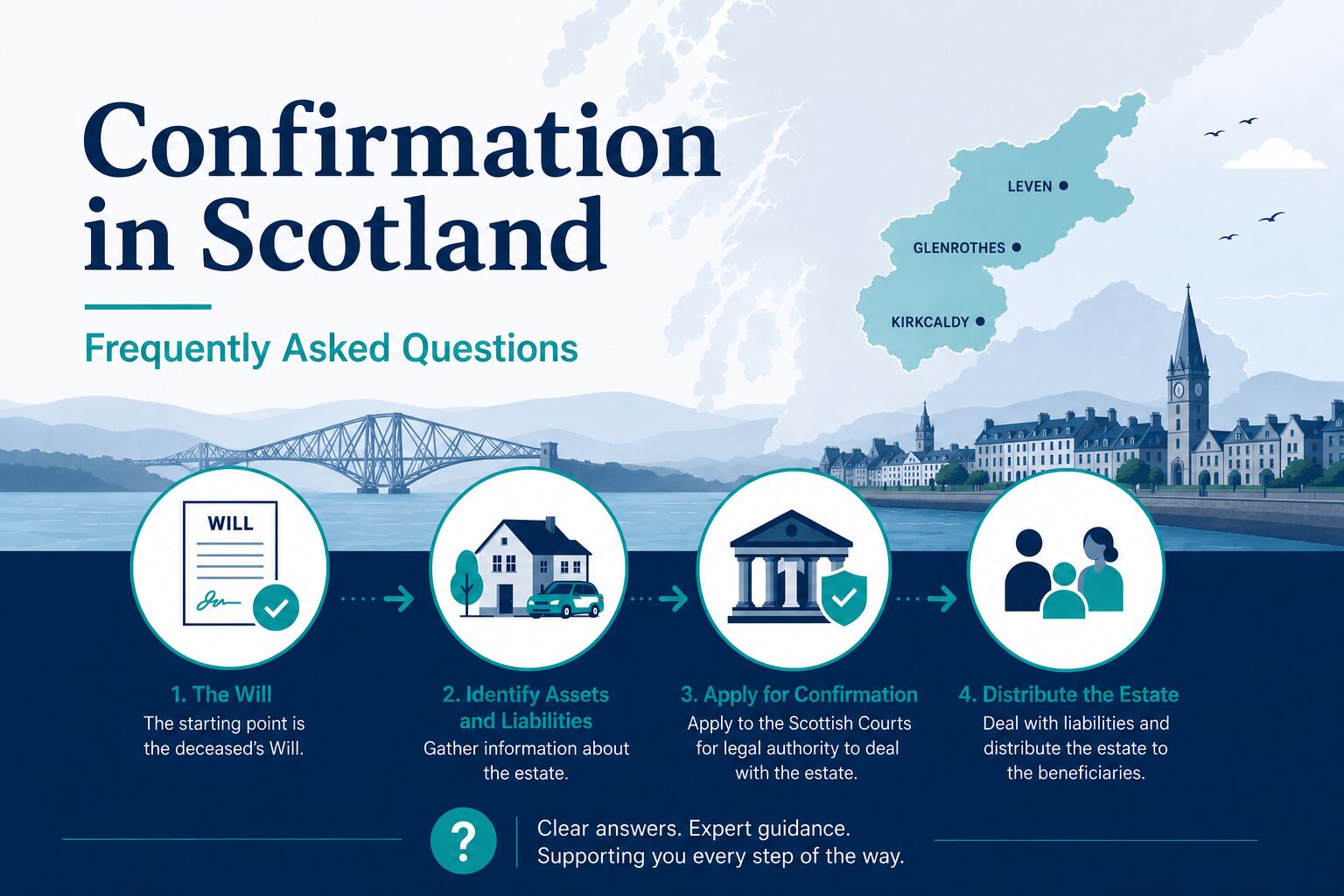
What is Confirmation?
Confirmation is the legal document that authorises an executor(s) to deal with a person’s estate after they die. This is also commonly known as “Probate” in England and Wales.
Once Confirmation is granted, it allows the executor to ingather funds from bank accounts, investments and other assets, sell or transfer property, and distribute the estate to the beneficiaries.
When is Confirmation needed?
Confirmation is usually required if the person who has died owned property or land, and/or assets that exceed certain values. Common examples include:
• Bank or building society accounts;
• Investments or shares;
• Life policies paid into the estate.
Most banks and institutions will release small balances to executors without Confirmation, but limits vary at each bank so it is important to check with each asset holder.
When might Confirmation not be required?
Confirmation may not be necessary where:
- Assets pass automatically by survivorship (for example, a jointly-owned bank account or property with a survivorship destination). If you are unsure whether you have a survivorship destination in your title deeds, we can review these and confirm.
- Financial institutions are prepared to release relatively small sums without requiring Confirmation.
- There are no assets requiring a formal transfer to a beneficiary by an executor, such as personal belongings already in the possession and control of the lawful beneficiary.
Who applies for Confirmation?
The executor of the estate applies for Confirmation. The executor can appoint a solicitor to assist in the administration of the estate and application for Confirmation.
If there is a Will, the executor should be named in it. We can advise on the processes required if a Will does not name an executor, or the executor is unable to act due to death or incapacity, or is unwilling.
If there is no Will, someone must apply to the court to be appointed as executor under the Succession (Scotland) Act 1964, which sets out the rules as to who can be appointed.
How long does the process take?
Timescales depend on a number of factors including:
• The size and complexity of the estate;
• Whether inheritance tax is due; and
• How quickly financial information can be obtained.
A straightforward estate may take around 6-9 months.
Under Scots law, the administration of any estate will take a minimum of 6 months. This is due to the 6‑month “creditors’ period,” during which creditors must be given the opportunity to submit claims against the estate before any final distribution can be made.
More complex estates will generally take longer.
How can Innes Johnston help?
We understand that dealing with a loved one’s estate can be emotional and overwhelming. Many executors instruct a solicitor because the process can be time consuming and technical—especially where property, tax issues or multiple beneficiaries are involved.
Administering an estate can be complex, and even honest mistakes can expose an executor to personal liability. Engaging a solicitor helps ensure the estate is administered in accordance with legal requirements, reducing the risk of errors, delays, disputes and unintended breaches of an executor’s duties.
At Innes Johnston, our aim is to provide clear, compassionate guidance from the outset. Whether you have been appointed as an executor under a Will, or you need to be appointed where there is no Will, we can support you through the full Confirmation process.
If you need assistance applying for Confirmation and administering an estate, please get in touch with our executry team.